

A New Framework for Understanding Cities
Introducing the Build Order City Deep Dives, starting with Columbus, Ohio

When Jen and I came up with the concept for Build Order over dinner off South Congress, we had already decided that we wanted to approach urban and real estate questions differently.
We didn’t want to simply ask whether a city was growing, what investors were doing in a particular submarket, or how a neighborhood was portrayed in the news. You can read all of that in a press release.
We wanted to ask a harder question: does a city’s growth work as a system?
That is the question real estate operators, startup founders, investors, and anyone thinking seriously about building a life in a particular city need answered. Not just “is this place hot right now?” but: what is driving the growth, what can absorb it, what might break under pressure, and what are the long-term prospects of this place?
That is why, today, we are launching the Build Order City Deep Dives.
For each city we cover, we’ll pair a one-hour conversation with a data-backed report to give you a sharper way to evaluate what it would mean to live, build, or invest there.
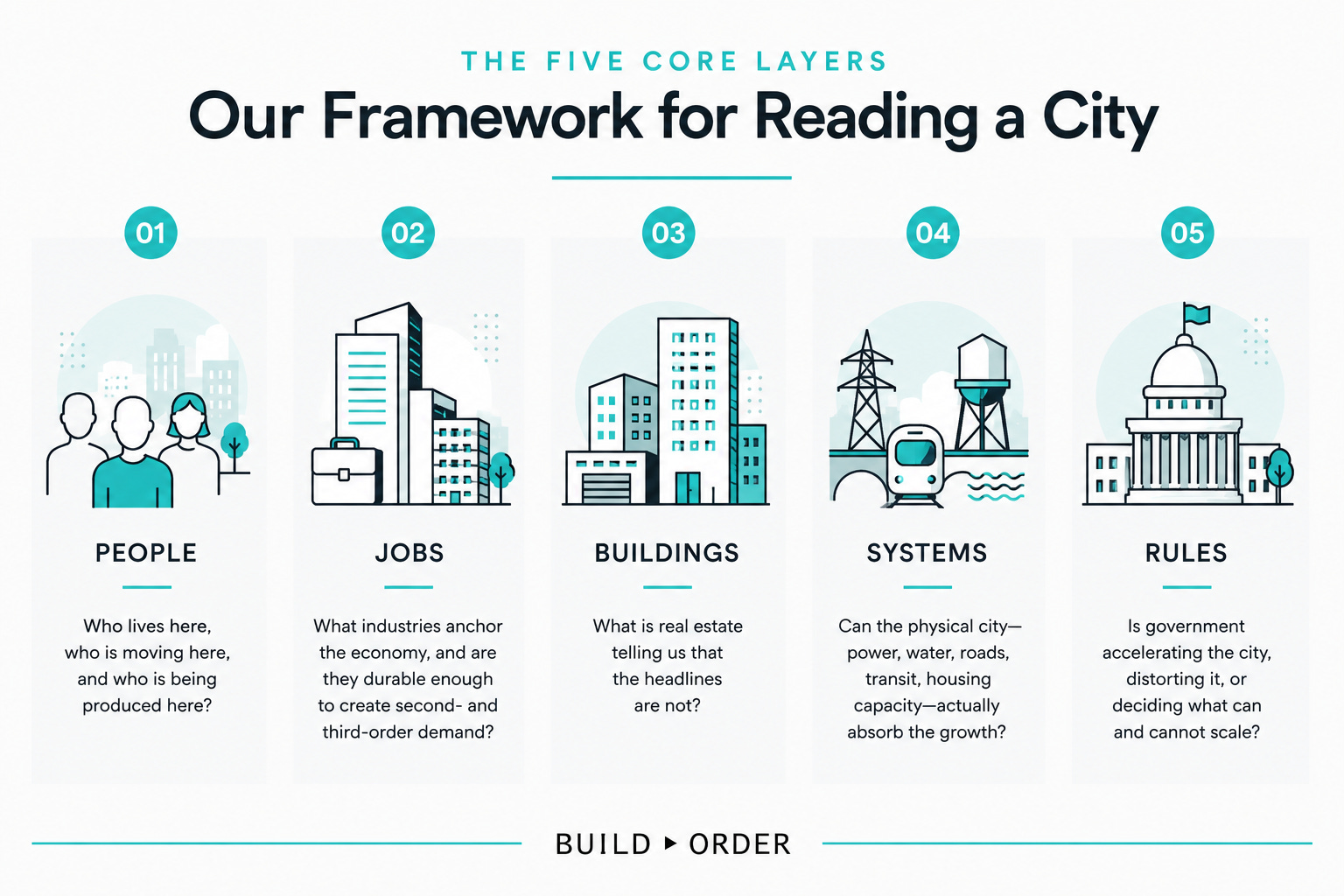
Each city analysis is backed by a five-layer framework exploring:
The people, or what the true demographic and migration numbers tell us
The jobs, or what industries will anchor the economy now and into the future
The buildings, or what real estate is telling us about the state of the market
The systems, or whether infrastructure can keep up with demand
And finally, the rules, or whether government is accelerating, distorting, or deciding what can or cannot scale
And for each city, we’ll ask what is working, what is fragile, where the upside is, and what could derail it. Then we’ll close with a simple decision framework: for people who choose to live, build, or invest there, where should they stop, start, or stay the course?
Our thesis is not that every city needs to excel on every metric to be investable. No city does. The point is that city growth has a set of ingredients and a sequence to things. Understanding that build order is what helps us judge whether a city’s imperfections are manageable or whether they threaten a particular long-term bet.
Our first city is Columbus, Ohio.
Columbus is one of the clearest examples of a city that is no longer silently big. It has major population momentum, moonshot advanced manufacturing and data center builds, a powerful university engine, and enviable logistics connectivity to the rest of the country and world. It also has the kind of infrastructure questions that could turn “growth story” into “systems test.”
Like all the cities we will cover, we will not simply ask whether Columbus is growing. We’ll be asking whether Columbus has the build order to sustain that growth — or even to become something much bigger.
Check out our first City Deep Dive, out today on Build Order.
-Lauren & Jen