

Your Electric Bill Isn’t Actually Subsidizing New Data Centers
Big tech is building its own power plants instead. That’s better for ratepayers. For now, and probably forever.

The fastest way to get electricity right now is not to ask the grid for it.
I know. That sounds crazy. But it’s exactly what’s happening, and the what it means for real estate, energy, and data centers is bigger than most people realize.
In June, Chevron — yes, the oil and gas company — signed a 20-year deal to become Microsoft’s power company. Not crude. Not natural gas. Electricity. Chevron’s subsidiary, Energy Forge One, partnered with investment firm, Engine No. 1, and will build a 2.67-gigawatt natural gas power plant in West Texas. Scalable to 5 GW. Price tag $7 billion+. First power targeted for 2028.
The plant sits “behind the meter,” or in other words, it’s connected to Microsoft’s AI data center campus next door. It never touches the public grid. And as a result, it never touches your electric bill (today, that is — and as we’ll show, it probably saves you money if and when it does).
And the craziest thing of all is that we’ve been here before.
tldr; It’s a great time to be in data centers, and an even better time to be in energy infrastructure (or at least financing it). When an industry grows too fast for power generation to keep up, it becomes cheaper to finance the construction of on-site power. We saw this with aluminum production in the early to mid 20th century and now we’re seeing it with AI. If history repeats itself, the value from building on-site power will long outlive the value of these AI training data centers.
This article is brought to you by Datacloud USA, the premier deal-making event bringing over 3,000 top decision makers across data centers, hyperscalers, energy, finance, and the public sector to Austin from September 2-3, 2026.
Join Lauren and Jen there by using code BUILDORDER10 for 10% off your pass.
Private power doesn’t stay private
Before there were data centers, there was aluminum.
In 1886, a chemist named Charles Martin Hall figured out how to isolate aluminum using electricity. But it took 10 kilowatts to produce a single pound. This was enough to burn a 40-watt lightbulb for ten days. And as you can imagine, it was significantly more power than was available in the late 1880’s. No grid in the country could deliver that kind of power at prices that made sense for production. So Hall’s company, originally called the Pittsburgh Reduction Company and now more commonly known as Alcoa, didn’t wait for the grid.
It built its own power.
In 1909, Alcoa began purchasing riparian rights along the Little Tennessee River in a search for cheap power. Over the next several decades, the company built six major dams in Tennessee and North Carolina, constructed an entire town around its smelting plant, and ran the whole system itself. By 1943, the aluminum industry was the largest single electricity user in the United States. Alcoa’s dams furnished half the company’s power. The other half came from the public grid.
That private industrial power gave Alcoa a strategic advantage that lasted over 80 years. Without those dams, the company couldn’t have realistically produced aluminum. At least not any that people could afford to buy.
Then, in 1941, Alcoa traded 1,500 acres at Fontana with the public grid, TVA, in exchange for TVA taking over the regulation of water flow across Alcoa’s river facilities. Not a seizure or eminent domain type of issue — a complementary, voluntary trade that made both work better. By the 2000s, Alcoa’s dam subsidiary was selling electricity to TVA, which in turn sold energy back to Alcoa. The private plants had become grid assets that still served their original owner, just intermediated. Smelter production ended in 2009. In 2012, Alcoa sold the four Tapoco dams to Brookfield Renewable for $600 million.
And then there’s Kaiser Aluminum. (Sidebar: My favorite article that I read in all of this research was titled, Helter Smelter, and led with “This time Charles Hurwitz [Kaiser’s owner] is in a real power struggle.” What a hook, amiright?!)
Kaiser’s Pacific Northwest smelters ran on long-term contracts with the public grid in the area, the Bonneville Power Administration. This gave Kaiser cheap federal hydro, starting at about $5 per megawatt-hour. But during the 2000–01 Western energy crisis, wholesale prices spiked 10-20x. Kaiser realized it could make more money selling its contracted power back to the grid than making aluminum. So naturally, it shut its Mead smelter — the first full shutdown since Henry Kaiser acquired the plant in 1946 — pocketed $52 million in a single month, and never fully reopened. Forbes reported that Kaiser stood to reap $500 million total by shutting down smelters and selling power at 20x the BPA contract price.
Hurwitz may have been unliked, but he sure was wealthy.
By summer 2001, all 10 aluminum smelters in the Pacific Northwest were shut down or running at minimal capacity. The power generation outlived its product generation. Because of course, in recent years, China produces the vast majority of aluminum globally.
Both stories tell us the same thing. Private industrial power works like a charm for the company that builds it, typically for decades. But the power infrastructure gradually becomes more valuable than what it was built to serve. At least from what we’ve seen with aluminum, that power doesn’t get confiscated. It becomes a grid asset.
Half that queue isn’t even real
Back to data centers. Especially those for training AI models.
Why are tech companies reaching back into a playbook that aluminum companies wrote a century ago?
Because the line for the grid is now measured in years — if you can even get through it.
Look at Texas. ERCOT’s large-load interconnection queue, which is the waiting list for anyone who wants to plug something big into the Texas grid, grew from about 63 gigawatts at the end of 2024 to 438,000 MW in June. Call it 89% of that is data centers.
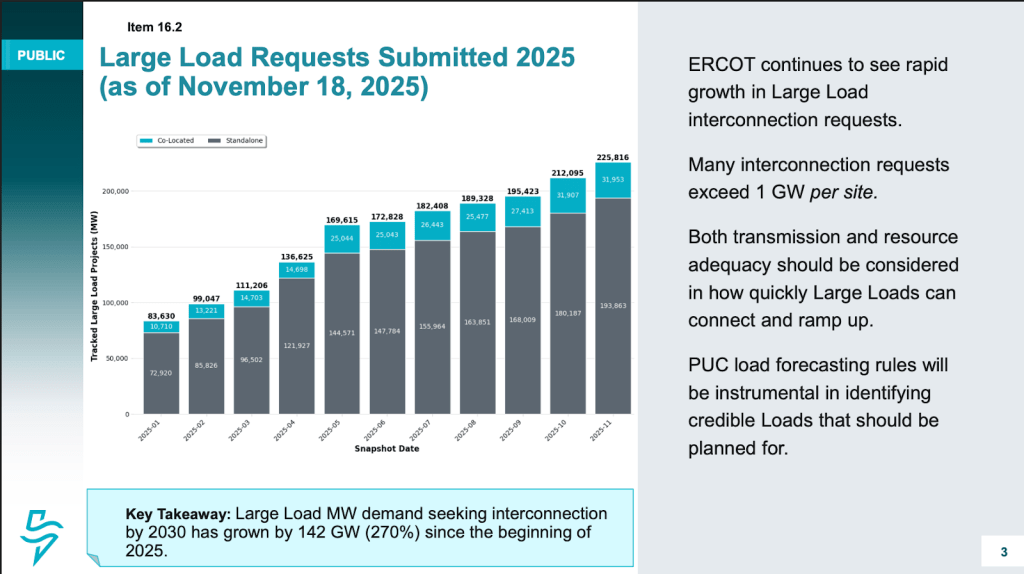
You’re probably like “Jen, but there can’t be that many data centers, right?” And you’d be right. Developers smartly shop the same project to multiple utilities. Both ERCOT and outside analysts think the queue overstates real demand by as much as 40%. In July, Governor Abbott signed a law directing the PUC to create new transparency requirements for large-load customers, including whether they have multiple similar interconnection requests under review. The rule is due this December.
And yet… Even discounted by nearly half, it’s still a massive multiple of anything the grid has ever absorbed. Per Lawrence Berkeley National Lab, projects nationally wait an average of four years from request to commercial operation. Only 13% of projects that entered queues between 2000 and 2019 actually made it to the finish line. Thirteen percent!
The scale of what’s coming is daunting, but again, we’ve been here before. What we saw with aluminum production was 0% of electricity consumed in the U.S. in 1886 to somewhere between 8-10% in 1943 at their peak. In 2024, data centers accounted for approximately 4% of total U.S. electricity consumption and are expected to reach 7 to 12% by 2028. Goldman Sachs projects that U.S. data centers will double their total electricity consumption between 2025 and 2027, and RAND projects that behind-the-meter capacity will roughly triple by 2030 to 49 gigawatts.
If you want to compete and win in AI model training, as the U.S. says it wants to, then you have to find a way to generate power faster.
So now, the biggest players are doing the thing that would have been unthinkable for a tech company even a few years ago. First, because of the insane cost somewhere in the billions. Second, because of the optics. For example, Microsoft made aggressive climate commitments, pledging to be carbon negative by 2030. Building a multi-gigawatt natural gas plant doesn’t exactly fit into the decarbonization plan.
And yet, here we are.
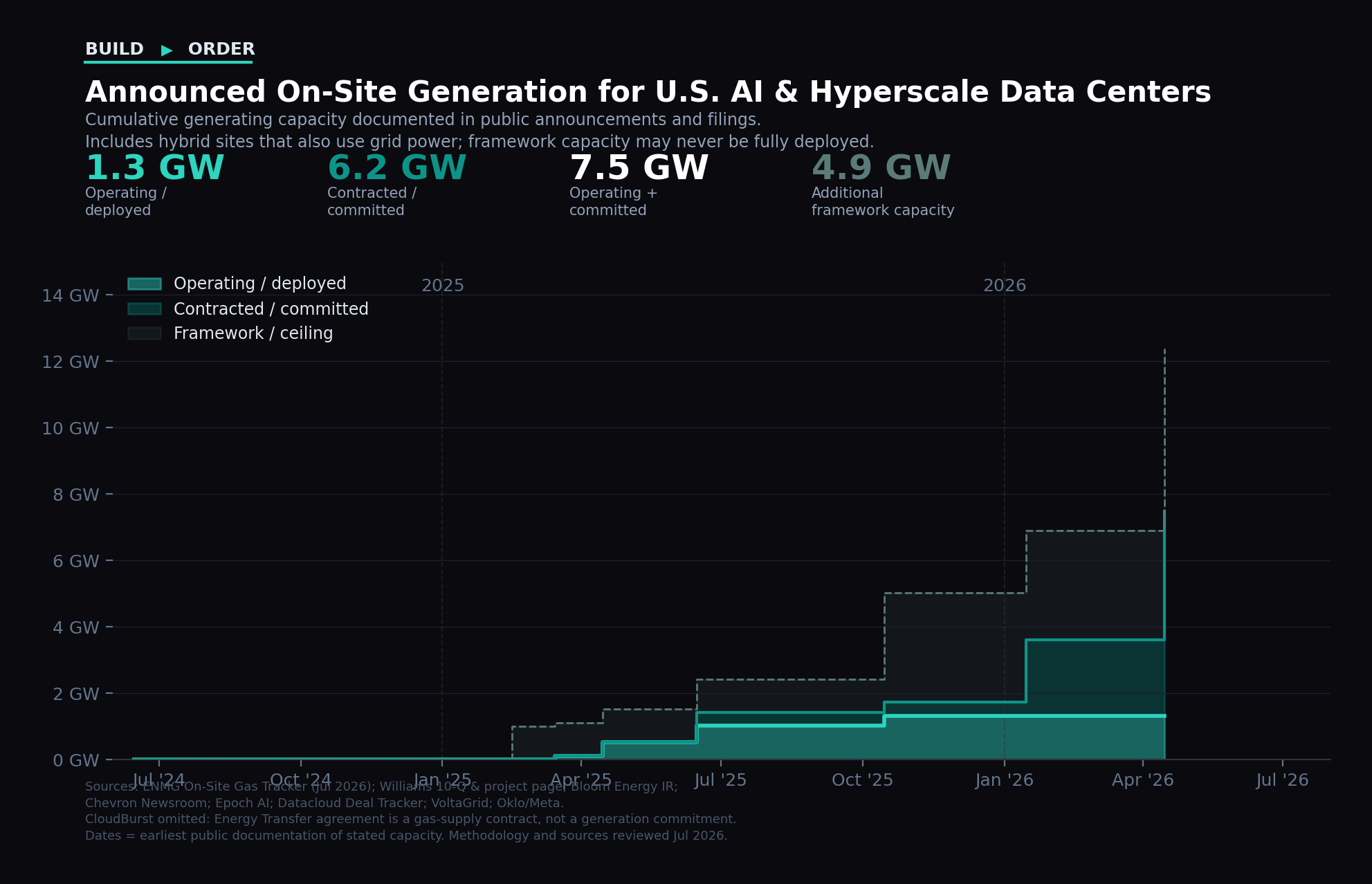
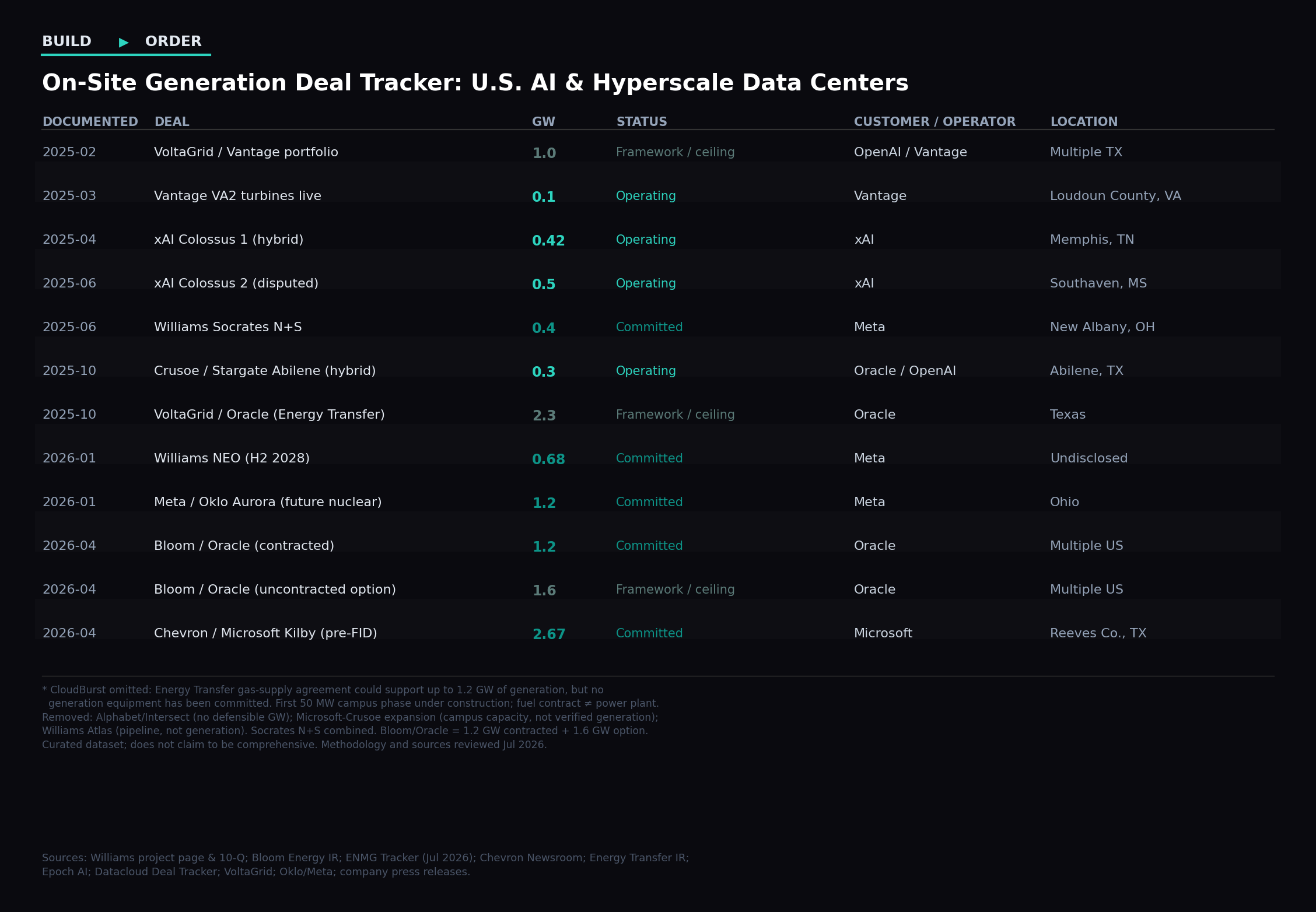
See sources at end for links to these projects.
The data center critics aren’t wrong
I think it’s important to say something that might be uncomfortable for the pro-development crowd. (Yes, people like me and probably you.) The people protesting data centers? Like my own family members? They’re not wrong.
About some things.
Elon Musk’s xAI got to the “build your own power” strategy first, in Memphis, and it shows the Kaiser way this can go. xAI’s Colossus supercomputers run partly on dozens of gas turbines installed without federal air permits in South Memphis and across the Mississippi state line. The NAACP sued under the Clean Air Act, arguing the turbines make the site one of the largest industrial polluters in a metro that already fails federal smog standards.
xAI’s response — to no one’s surprise who’s ever read an Elon tweet — to the February legal notice was to add six more turbines. In June, the Justice Department intervened on xAI’s side (former DOGE help, anyone?), calling the data center a national security asset. DOJ counsel Stanley said that in the modern theater of operations, “data center inference capacity must be recognized not merely as commercial infrastructure, but as a long-term strategic tool vital to maintaining our technological advantage against adversaries.”
And it’s not just xAI. The same week we’re publishing this, the New York Times detailed how Meta extracted a secret, NDA-protected deal from Louisiana officials for its $50 billion Hyperion campus. No bueno.
Back to the Chevron-Microsoft deal. A WIRED analysis, reproduced by Grist, put Energy Forge’s emissions at more than 11.5 million tons of CO₂ equivalent a year — more than Jamaica’s 2024 national emissions. While this is not Chevron-confirmed disclosures, and of course Chevron says they’re working on reducing emissions with newer fuel generation methods, Chevron is still now underwriting decades of new combustion.
Fortunately (and not by accident), Kilby was built in the empty Permian under a public 20-year contract. But for projects not well-thought out in terms of site selection are generating a backlash that impacts all data center developers. So it doesn’t matter if you’re doing a lot of good because one guy (sound familiar, Hurwitz?) will drag everyone through the mud with him.
And about your electric bill
Here’s the part that surprises most people, including me when I first dug into it.
Behind-the-meter generation means the data center’s power demand never touches the rate base. Ratepayers don’t fund the grid upgrades to serve it. Senate Bill 6 was literally written to make this explicit — if a data center’s demand doesn’t materialize or gets curtailed during a grid emergency, the cost lands on the data center. Not on households. Not on you.
Think about that. The tech company building its own gas plant in the middle of the Permian is actually better for your electric bill than the tech company plugging into your grid. That’s not the story most people have in their heads. But it’s the math.
And if history repeats itself, as it often does, that new power generation will be cheaper for you than the grid in a few decades’ time.
So what happens next
Remember Alcoa. Remember Kaiser. The power generation outlived the product generation.
The risk for Chevron and Microsoft isn’t that the government confiscates their power plant. It’s that AI training demand shifts, the chips change, Microsoft’s buildout plans evolve, and somebody is holding a 5 GW gas plant whose most logical next buyer is the grid. That could actually be an excellent outcome for Chevron (selling power to ERCOT is a real business), but it’s not the outcome they’re financing today.
And Texas is already writing the regulatory bridge to that ending. Senate Bill 6 requires ERCOT approval for new co-located arrangements, mandates a grid-controlled “kill switch” on behind-the-meter loads, and lets ERCOT order big on-site generators to feed the public grid during emergencies. On paper, Kilby is off-grid. In law, its interconnection is half-written.
“Everyone builds their own power” is not an exit from the grid. It’s a profitable detour that always ends back on it. Every precedent we have — the dams, the smelters, the blast furnace powerhouses — says private industrial power works brilliantly for the company that builds it, until the power infrastructure becomes worth more than what it was built to serve. The queue-skippers of 2026 are being quietly pre-registered as the grid’s emergency capacity. And if the aluminum precedent holds, some of these plants will outlive the training clusters they were built for and end up powering everyone.
Saving us all money. 10-20x more.
The near-term cost is a fast, loosely supervised power buildout. Whether your town gets the Permian version or the Memphis version depends mostly on who’s watching.
So as we said, the fastest way to get electricity in Texas right now is not to ask the grid for it. But the fastest way back onto the grid? Build a power plant so big that the grid eventually needs you.
Or you could say, wants you back.

This essay grew out of a Build Order conversation. If you haven’t caught it yet, you can watch or listen to our episodes on your favorite platforms: Substack, YouTube, Spotify, Apple Podcasts, Pocket Casts, iHeartRadio, and Overcast.
Source Links: On-Site Generation Deal Tracker
Operating / Deployed
Vantage VA2 turbines live (0.10 GW, Loudoun County, VA) — ENMG On-Site Gas Generation Tracker, Shale Magazine
xAI Colossus 1 (0.42 GW, Memphis, TN — hybrid) — ENMG On-Site Gas Generation Tracker, Shale Magazine
xAI Colossus 2 (0.50 GW, Southaven, MS — disputed) — Mississippi Today, Apr 2026
Crusoe / Stargate Abilene (0.30 GW — hybrid) — Epoch AI Stargate Site Tracker
Contracted / Committed
Williams Socrates N+S (0.40 GW, New Albany, OH) — Primary: Williams Socrates Project Page; Secondary: Tech Investments
Williams NEO (0.68 GW, H2 2028) — ENMG Tracker, Shale Magazine; Williams Q1 2026 Earnings Recap
Meta / Oklo Aurora (1.20 GW, Ohio — future nuclear) — Datacloud Global Congress Deal Tracker
Bloom / Oracle — contracted portion (1.20 GW) — Primary: Bloom Energy Investor Relations; Secondary: EnkiAI
Chevron / Microsoft Kilby (2.67 GW, Reeves Co., TX — pre-FID) — Global Data Center Hub
Framework / Ceiling
VoltaGrid / Vantage portfolio (1.00 GW, Multiple TX) — Datacloud Deal Tracker; ENMG Tracker
VoltaGrid / Oracle via Energy Transfer (2.30 GW, Texas) — ENMG Tracker, Shale Magazine
Bloom / Oracle — uncontracted option (1.60 GW) — Bloom Energy Investor Relations
Omitted — with explanation
Energy Transfer / CloudBurst — Gas-supply agreement could support up to 1.2 GW of generation, but no generation equipment committed. First 50 MW campus phase under construction; fuel contract ≠ power plant. Source: Energy Transfer Investor Relations
Alphabet / Intersect Power — Acquisition of power development platform. No defensible GW figure attributable to behind-the-meter generation. Source: Capacity Global
Microsoft-Crusoe Abilene expansion — 900 MW is campus/compute capacity, not verified on-site generation. Source: Epoch AI Stargate Tracker
Williams Atlas — Pipeline capacity agreement, not electrical generation. Source: Williams 10-Q (SEC EDGAR)
Data viz methodology
Curated dataset of U.S. AI and hyperscale data center projects with documented on-site generation commitments. Does not claim to be comprehensive. Inclusion requires a generation equipment commitment (turbine order, fuel cell deployment, or signed power-plant development agreement) — gas-supply contracts alone are excluded. Methodology and sources reviewed Jul 2026.